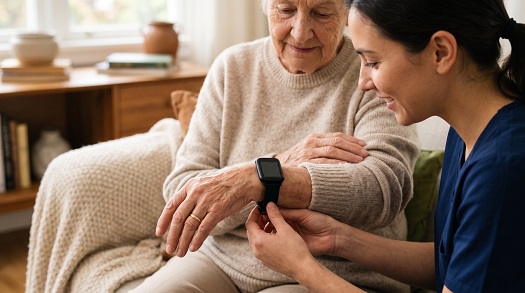
Remote health monitoring in home care uses connected sensors, wearables, and automated alerts to track a person’s health in real time from his or her own home. These tools help caregivers and family members stay informed and respond quickly without requiring constant in-person visits.
What Types of Sensors Are Used in Home Health Monitoring?
Home health monitoring relies on a range of sensors designed to track environmental and physiological conditions:
- Motion sensors detect movement patterns and can flag unusual inactivity.
- Fall detection sensors identify sudden drops and trigger immediate alerts.
- Door and window sensors monitor whether individuals are leaving or entering safely.
- Temperature and humidity sensors ensure a comfortable and safe living environment.
- Bed and chair occupancy sensors track rest patterns and time spent sedentary.
Many of these sensors are discreet, battery powered, and can be installed without professional help.
Remote monitoring can be especially helpful for keeping track of seniors with dementia, who often tend to wander. Caring for seniors with dementia can be challenging for family caregivers. Luckily, there is dementia home care Barrie families can rely on. Professional dementia caregivers help seniors with dementia stay safe and comfortable at home by preventing wandering, providing cognitive stimulation, and assisting with household chores.
What Wearables Are Commonly Used for Remote Health Monitoring?
Wearable devices are among the most widely adopted tools in Canadian home care programs:
- Smartwatches (such as the Apple Watch or Samsung Galaxy Watch) track heart rate, blood oxygen, and activity levels.
- Personal emergency response systems (PERS) are wrist or pendant devices that allow users to call for help with a single button press.
- Continuous glucose monitors (CGMs) like the Dexcom G7 track blood sugar levels in real time for individuals with diabetes.
- ECG monitors detect irregular heart rhythms and can sync data directly to a caregiver or physician.
- Smart patches adhere to the skin and measure vital signs like respiratory rate and body temperature.
Canadian health technology programs, including some provincial telehealth initiatives, have begun integrating wearables into structured home care plans.
How Do Automated Alerts Work in Remote Health Monitoring Systems?
Automated alerts are triggered when sensor or wearable data falls outside a preset threshold:
- A heart rate that drops or spikes beyond a safe range sends an immediate notification.
- A fall detection event triggers an alert to a designated contact or monitoring service.
- Prolonged inactivity, such as no movement detected for several hours, can prompt a wellness check.
- Missed medication reminders escalate if not acknowledged within a set timeframe.
Alerts can be sent via SMS, app notification, or phone call, and most platforms allow family members, caregivers, and health providers to receive them simultaneously.
What Are the Privacy Considerations for Remote Health Monitoring in Canada?
Privacy is a key concern for Canadians using remote health monitoring. Under Canada’s Personal Information Protection and Electronic Documents Act (PIPEDA), organizations collecting health data must obtain informed consent and protect information from unauthorized access. Key considerations include:
- Choosing platforms that store data on Canadian servers or comply with Canadian privacy law
- Understanding who has access to your health data and for what purpose
- Reviewing whether data is shared with third parties, including insurance providers
- Ensuring devices are secured with strong passwords and regular software updates
What Are the Key Benefits of Remote Health Monitoring for Home Care?
Remote health monitoring offers measurable advantages for individuals living at home:
- Increased independence – Individuals can live at home longer with safety systems in place.
- Faster response times – Automated alerts reduce the delay between a health event and a response.
- Reduced caregiver burden – Real-time data gives family members and professional caregivers visibility without requiring constant physical presence.
- Better data for health decisions – Continuous monitoring provides richer health insights than periodic appointments alone.
- Cost savings – Remote monitoring can reduce unnecessary hospital visits and emergency calls.
Remote monitoring is a useful tool, but it can’t replace the supervision and personalized care a senior gets from an in-home caregiver. One of the most challenging tasks of helping an elderly relative age in place safely and comfortably is researching agencies that provide the best Barrie homecare services. You can turn to Home Care Assistance for reliable, high-quality in-home care for aging adults. We offer 24-hour live-in care for seniors who require extensive assistance, and we also offer respite care for family caregivers who need a break from their caregiving duties.
Living independently is important for seniors who want to maintain a high quality of life. For some, this simply means receiving help with tasks that have become more challenging to manage over time. Even when families have the best intentions, they may not have the time to provide the care their elderly loved ones need and deserve. If your loved one needs help for a few hours a day or a few days a week, reach out to Home Care Assistance, a trusted provider of respite and overnight home care for Barrie-area seniors and their families. To talk to one of our friendly Care Managers and create a customized senior care plan, call us.
Frequently Asked Questions
Is remote health monitoring covered by provincial health plans in Canada?
+
Coverage varies by province. Some programs, like Ontario’s Home and Community Care Support Services, include funded remote monitoring options for eligible individuals.
Do remote health monitoring devices require a strong internet connection?
+
Most devices require a stable Wi-Fi or cellular connection to transmit data reliably, though some systems can store data locally and sync when connectivity is restored.
How accurate are wearable health monitoring devices?
+
Accuracy varies by device and metric. Clinical-grade wearables like CGMs and ECG monitors are generally more accurate than consumer-grade smartwatches for medical purposes.
Who receives the alerts generated by a remote health monitoring system?
+
Alerts can be customized to reach family members, professional caregivers, or a 24/7 monitoring service, depending on the platform and care plan in place.
Can remote health monitoring systems be used for seniors living alone?
+
Yes, remote monitoring systems are especially well suited for seniors living independently, as they provide continuous oversight without requiring a caregiver to be physically present.